A Rouge-Kissed Brutalist Landmark: Jaipur’s Bold New Restaurant
For Mirove Artisanal Kitchen, Pantone Collective recasts the city’s pink legacy through a contemporary lens, pairing indigenous details with serene shades, sculptural forms and a seamless indoor-outdoor experience.
- 1 Dec '25
- 6:38 pm by Nupur Sarvaiya

Landmarks aren’t manifested in a moment. They’re assembled over time, brick by brick, shard by shard, like fragments of memory coming together. What begins as a story transforms into a symbol, and eventually, into something you can see and feel. In Jaipur, this very collective consciousness often finds its pulse in pink, a hue that has long transcended pigment to become identity. When Tanya Chutani, founder and principal architect of New Delhi-based firm Pantone Collective, began envisioning Mirove Artisanal Kitchen in the heart of Jaipur’s C-Scheme district, she knew the narrative had to begin with colour.
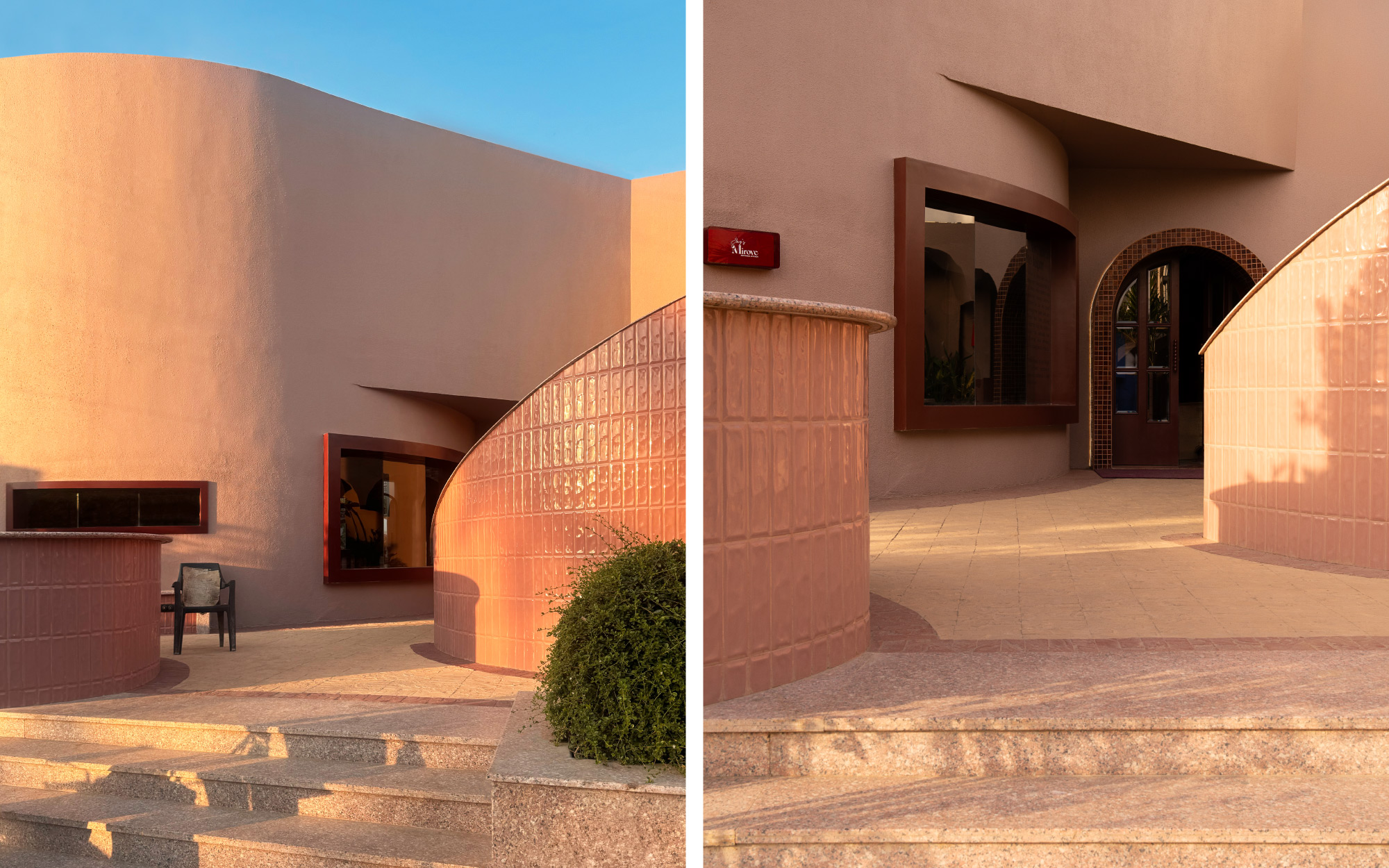
“At Pantone Collective, every project is defined by a distinct colour identity that captures both place and emotion,” avers Chutani. “For Mirove, the client envisioned a contemporary dining destination that resonated with Jaipur’s cultural spirit without relying on traditional motifs. We translated this vision through our signature aesthetic by reinterpreting the iconic Pink City hue into a refined, monotonal palette that feels modern yet rooted.”
A Modern Monument
Set on what was once a barren plot, the 8,000 sq. ft. restaurant now stands as a sculptural testament to the city’s evolving architectural landscape, grounded in brutalist restraint yet rich in vernacular spirit. The 60-foot-wide curved façade is the project’s first act of theatre. Cast in concrete and kissed by a muted rouge tone, it captures the afternoon sun like sandstone that’s tactile and alive.
Also Read: 2D Airbnb Architectural Heritage: Palace Magic Unveiled
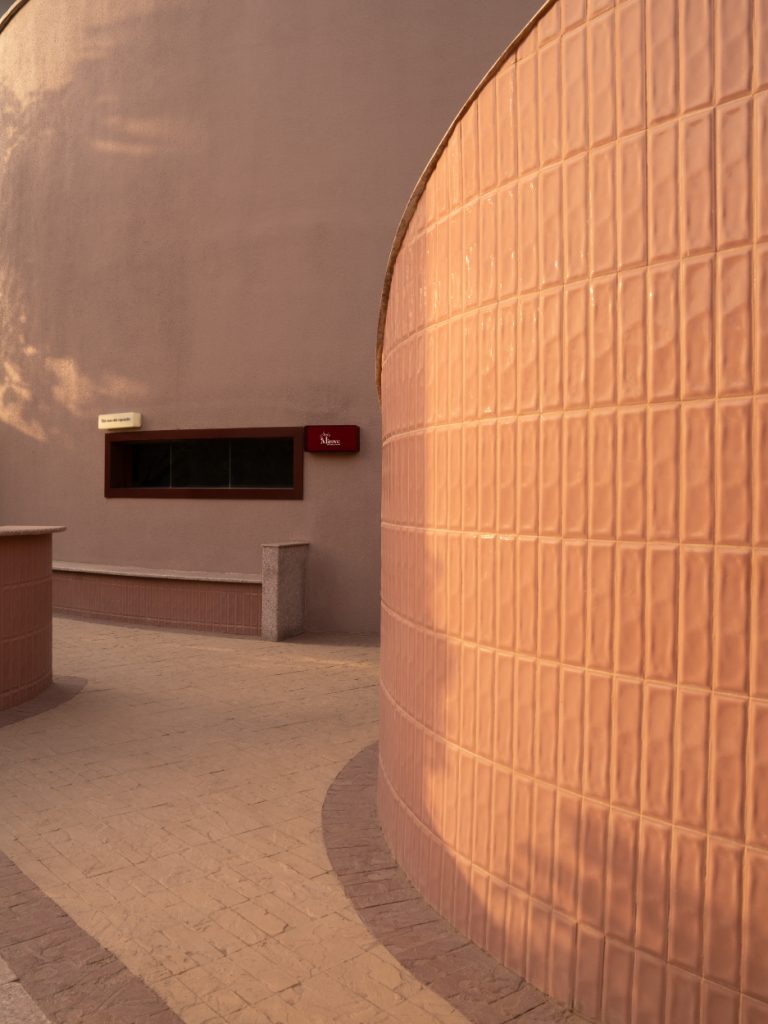
Chutani describes this façade as “a bold architectural gesture that immediately draws you in.” The play of proportion and curvature not only creates an urban landmark but also hints at the spatial purity that unfolds within. The moment you enter, the architecture seems to exhale. It feels monumental yet meditative, raw yet romantic. The detailing here is meticulous: the joinery invisible, the finish intentional and the form monolithic, echoing the fluid geometries of Jantar Mantar.
The Heart of the Space
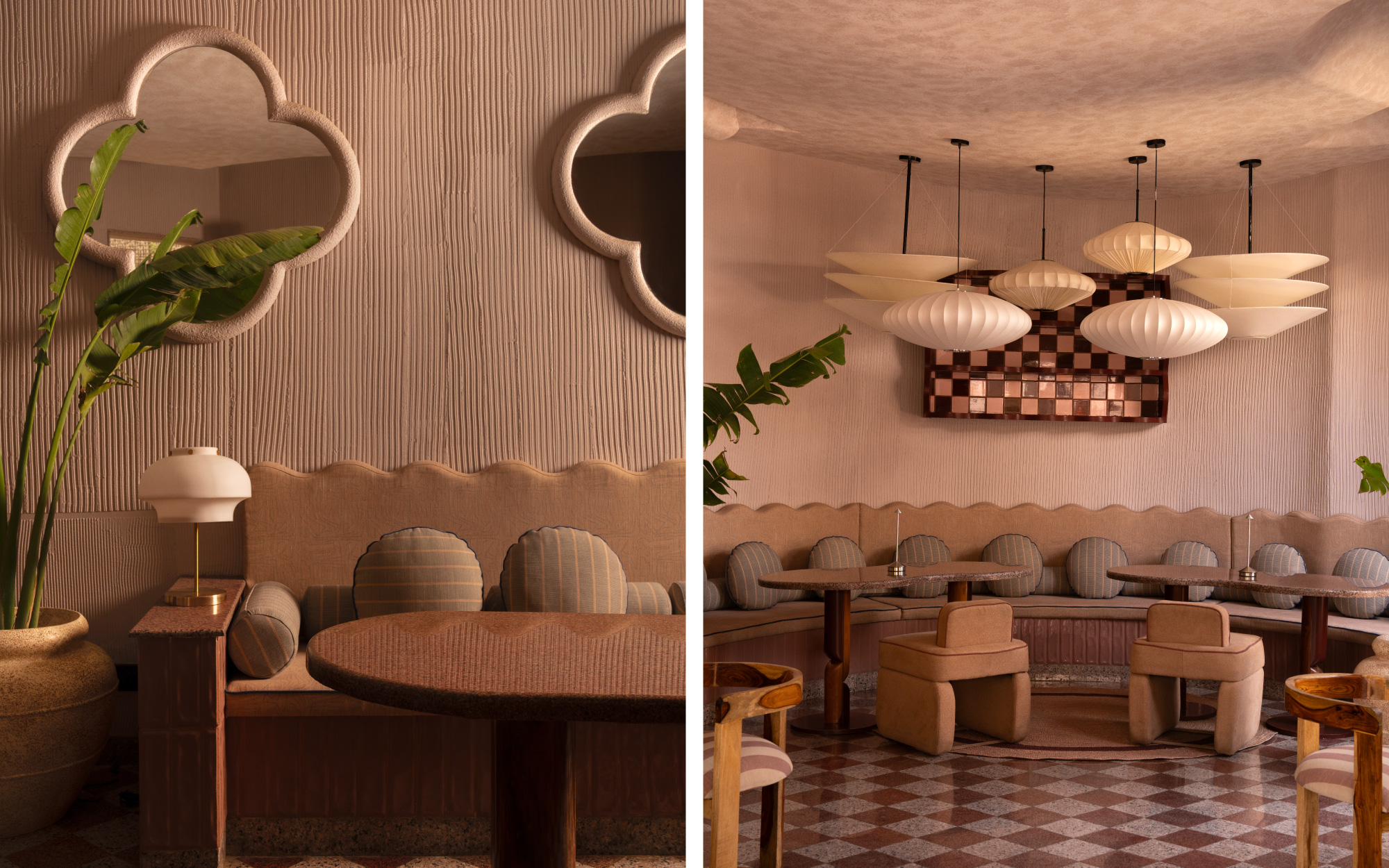
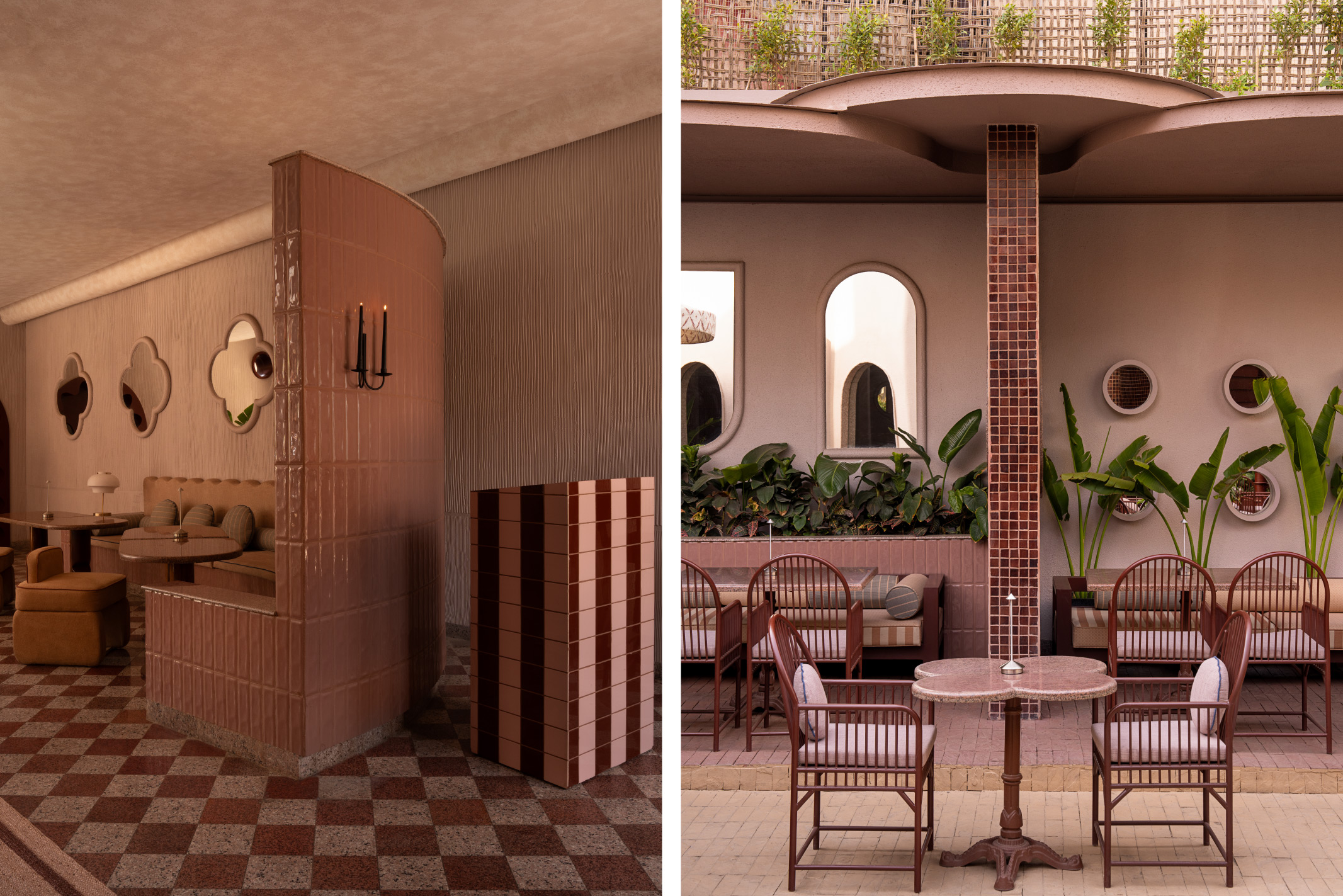
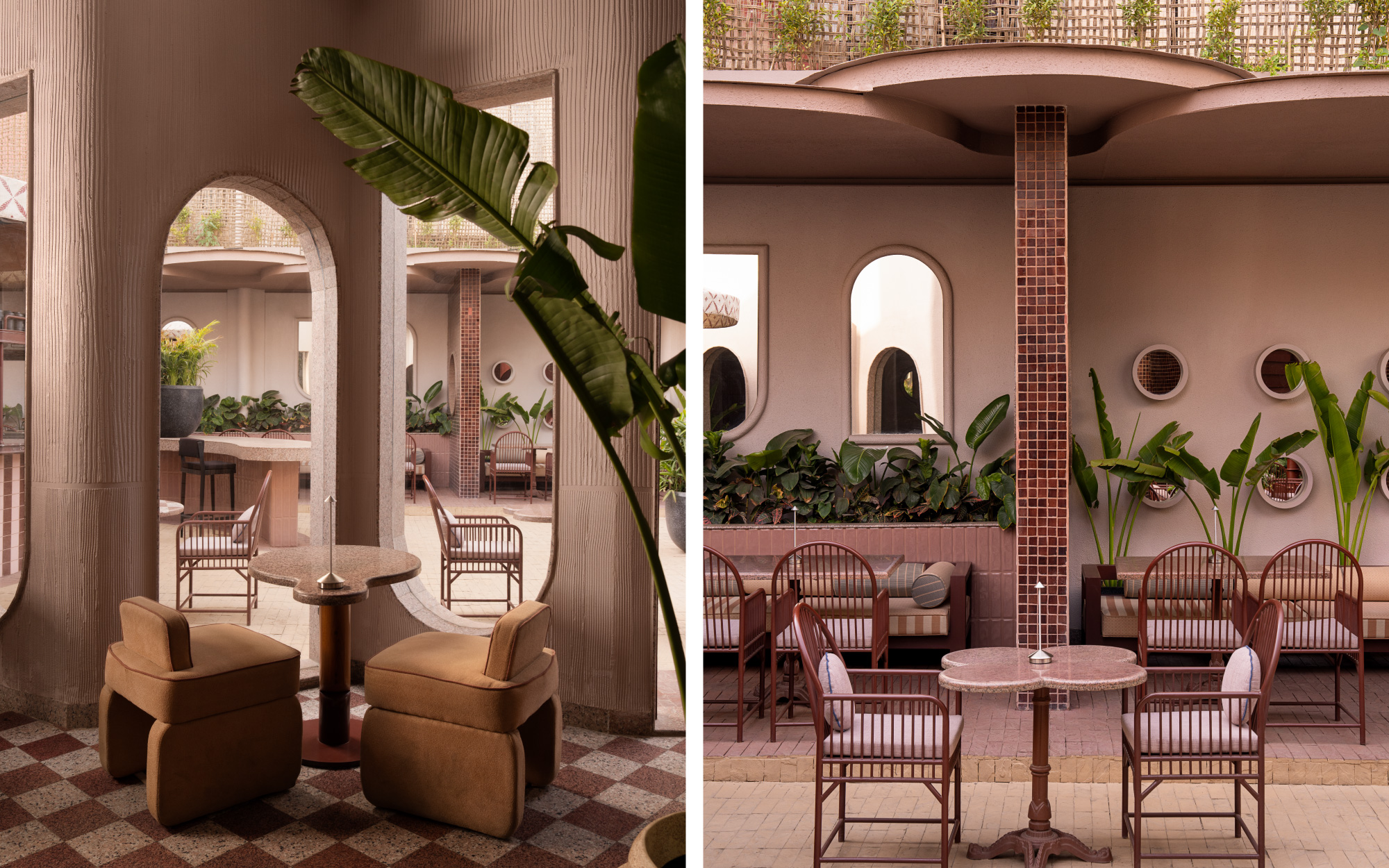
Stepping through the main threshold, you are greeted by a soaring volume where the light bounces off the walls. The walls, finished in sand-textured plaster, vary in grain, some smooth like polished sandstone, others rugged and raw, all reminiscent of volatile desert dunes. The flooring, a handcrafted checkered pattern in rouge granite, was locally sourced and laid with traditional craftsmanship.
Also Read: An Arresting Eatery In Udaipur, Which Is A Rajasthani Design Lover’s Dream Come True
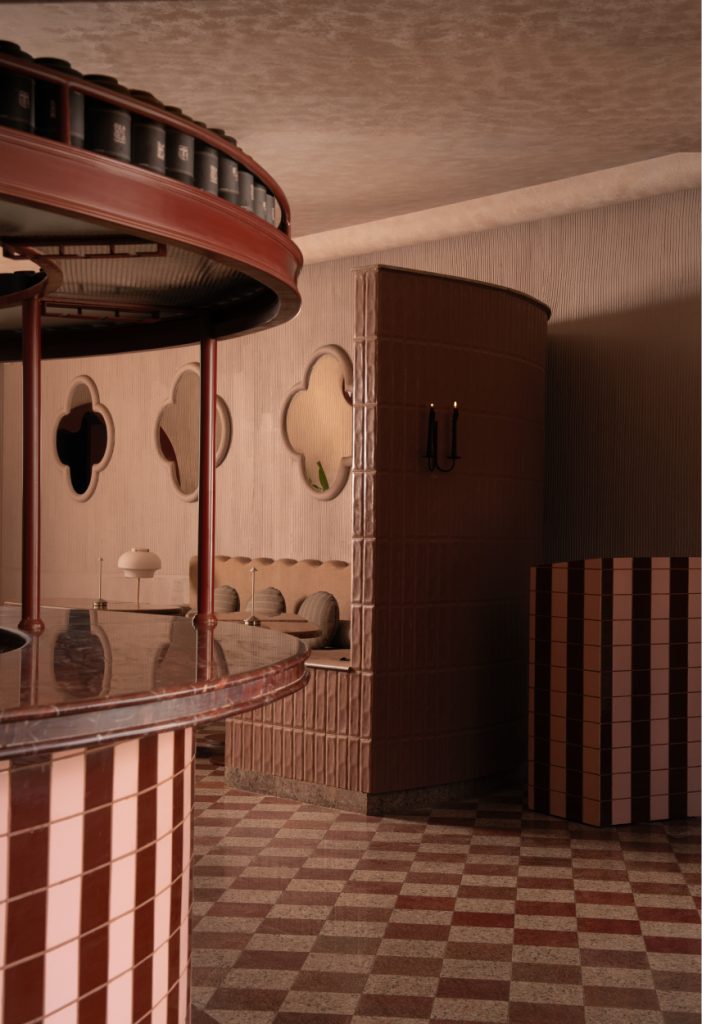
At the centre stands Mirove’s pièce de resistance: a 360-degree bar that forms the spatial and emotional heart of the restaurant. “The sculptural bar becomes the central anchor,” reinstates Chutani. “It seamlessly connects the indoor dining on your left and the open courtyard on your right. This fluid transition blurs the boundary between interior and exterior, allowing the space to breathe and drawing the two environments into one seamless flow.”
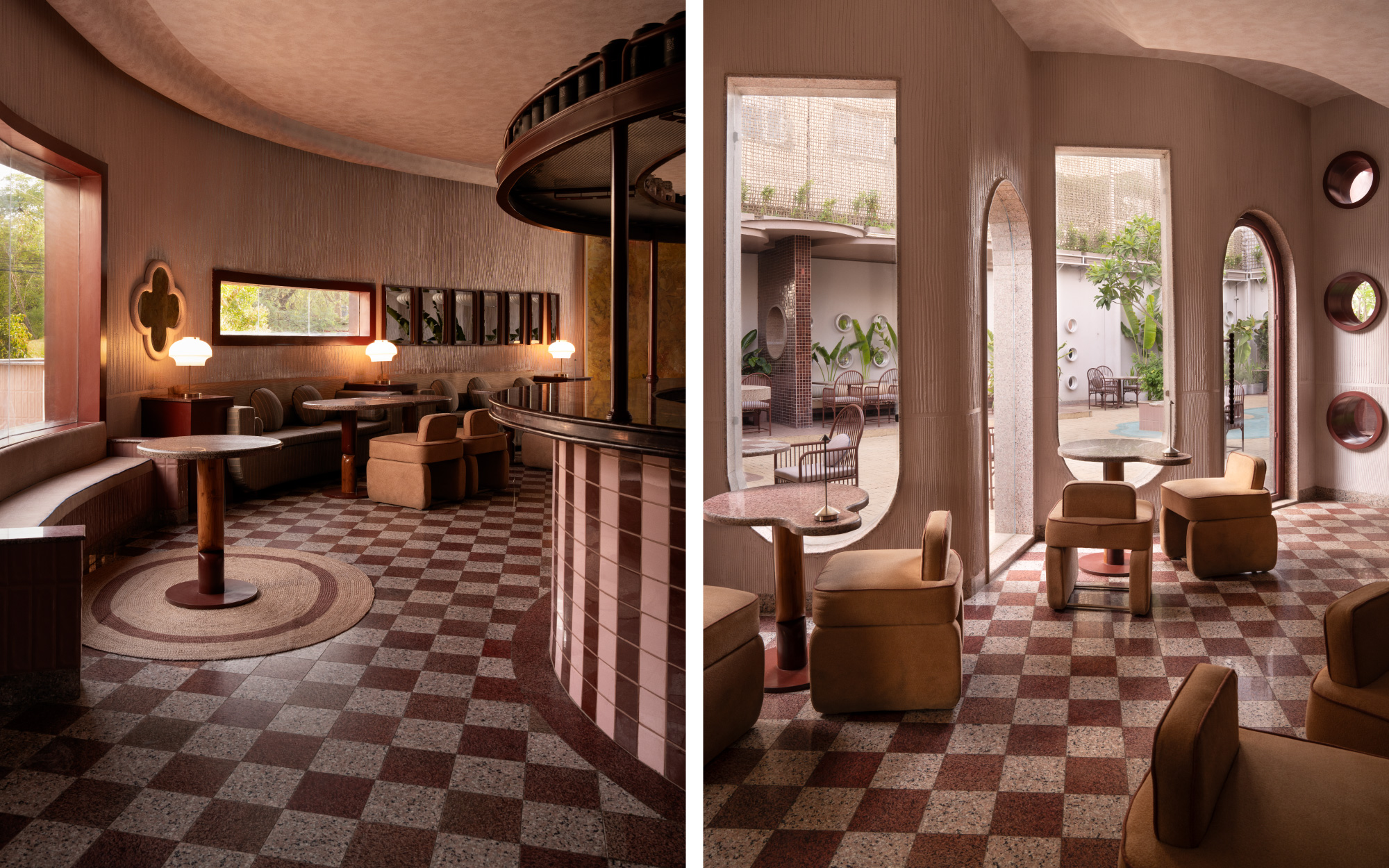
Wrapped in custom-glazed rouge tiles, the bar delivers a bold, contemporary contrast. The glossy undulations juxtapose with the matte roughness of the walls and glisten under soft, ivory-toned lights. The tactile tension between the two, “invites touch and curiosity.”
The Geometrical-Meets-Emotional Indoor Dining
Also Read: An Unforgettable Royal Experience At Jaipur’s Iconic City Palace In Collaboration With Airbnb
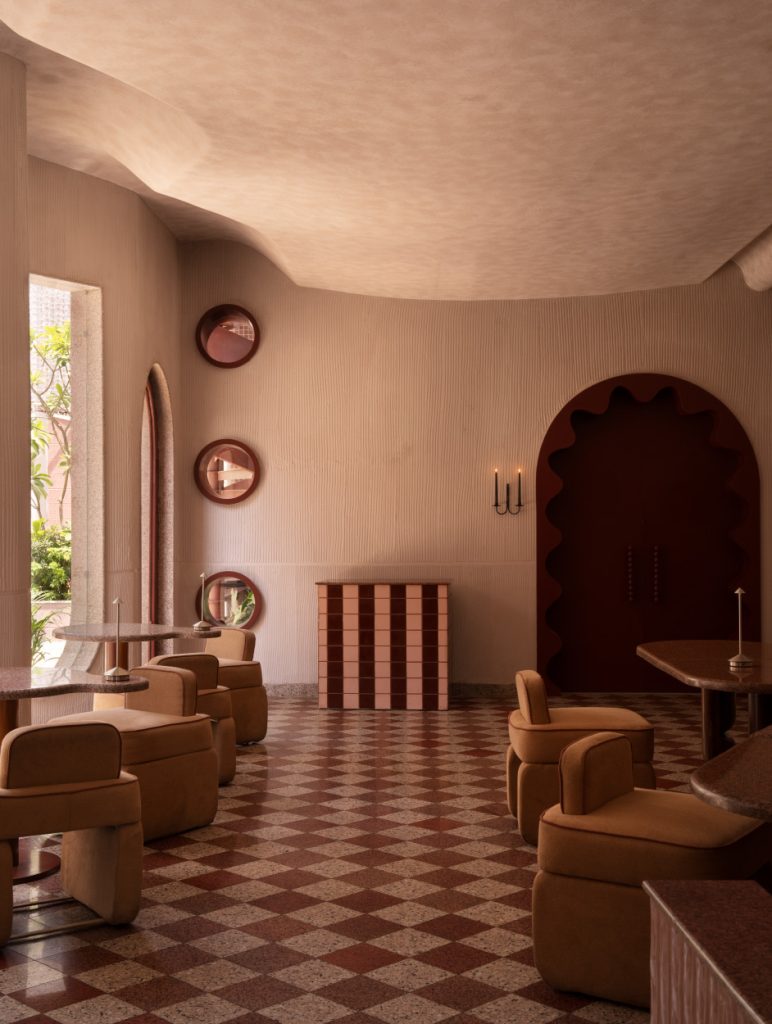
To the left of the bar lies the indoor lounge and dining area, defined by rhythmic arches and inverted profiles that create continuity and surprise. The design draws heavily from Jaipur’s design typologies, from arches to domes, but distils them into a language of modern minimalism.
Circular punctures pierce through the monolithic walls, softening their mass and framing the changing light throughout the day. “From any point, you can trace the gentle curvature of the walls, the rhythm of the fins and the play of light across the checkered stone floor,” Chutani notes. “Each zone unfolds organically, inviting guests to explore, pause, and engage with the architecture as much as the experience itself.”
The Custom Courtyard
On the right of the bar, a courtyard-like space opens up as a quiet interlude that feels grounded and celestial. As ascending fin walls rise, their narrow gaps let in slivers of sunlight that travel across the floor like clock hands, tracing time through light. “Light was our key collaborator,” Chutani reflects. “The west-facing façade captures the golden hour in the most cinematic way, turning the space into a canvas of shadows and warmth.” This space is Mirove’s contemplative core: it is part lounge, part installation. It’s where architecture and sky converse, and the shifting shadows create a living artwork that evolves with every hour.
Also Read: Assouline’s New Book, Jaipur Splendor Pays Homage to The Pink City
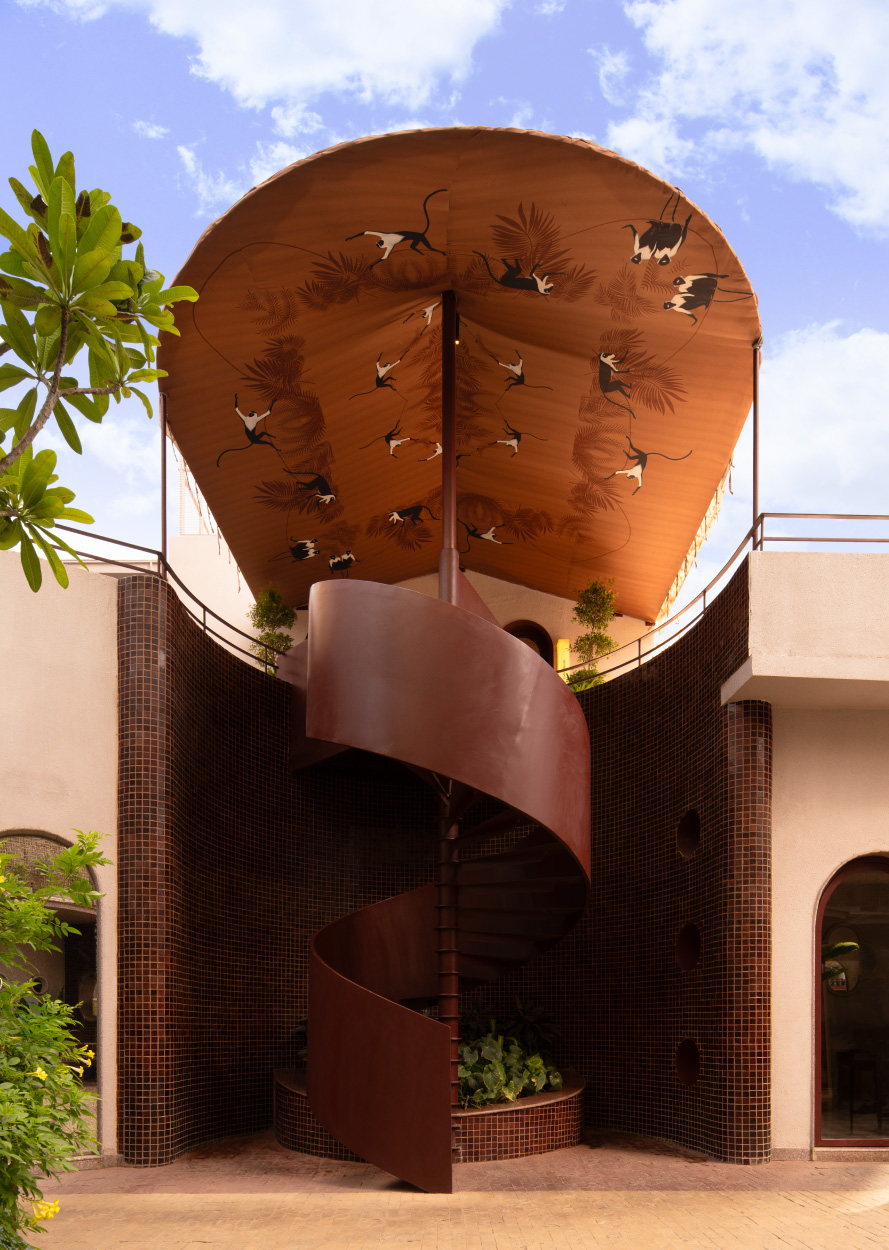
Rising in a graceful sweep, the spiral staircase commands the courtyard with its sculptural presence. Its deep red curvature complements the gridded mosaic wall behind, where round openings frame shifting pockets of light. Above, a lively canopy of illustrated monkeys introduces a tropical whimsy that contrasts the sculptural rigour.
Bespoke Furniture and Furnishings That Belong
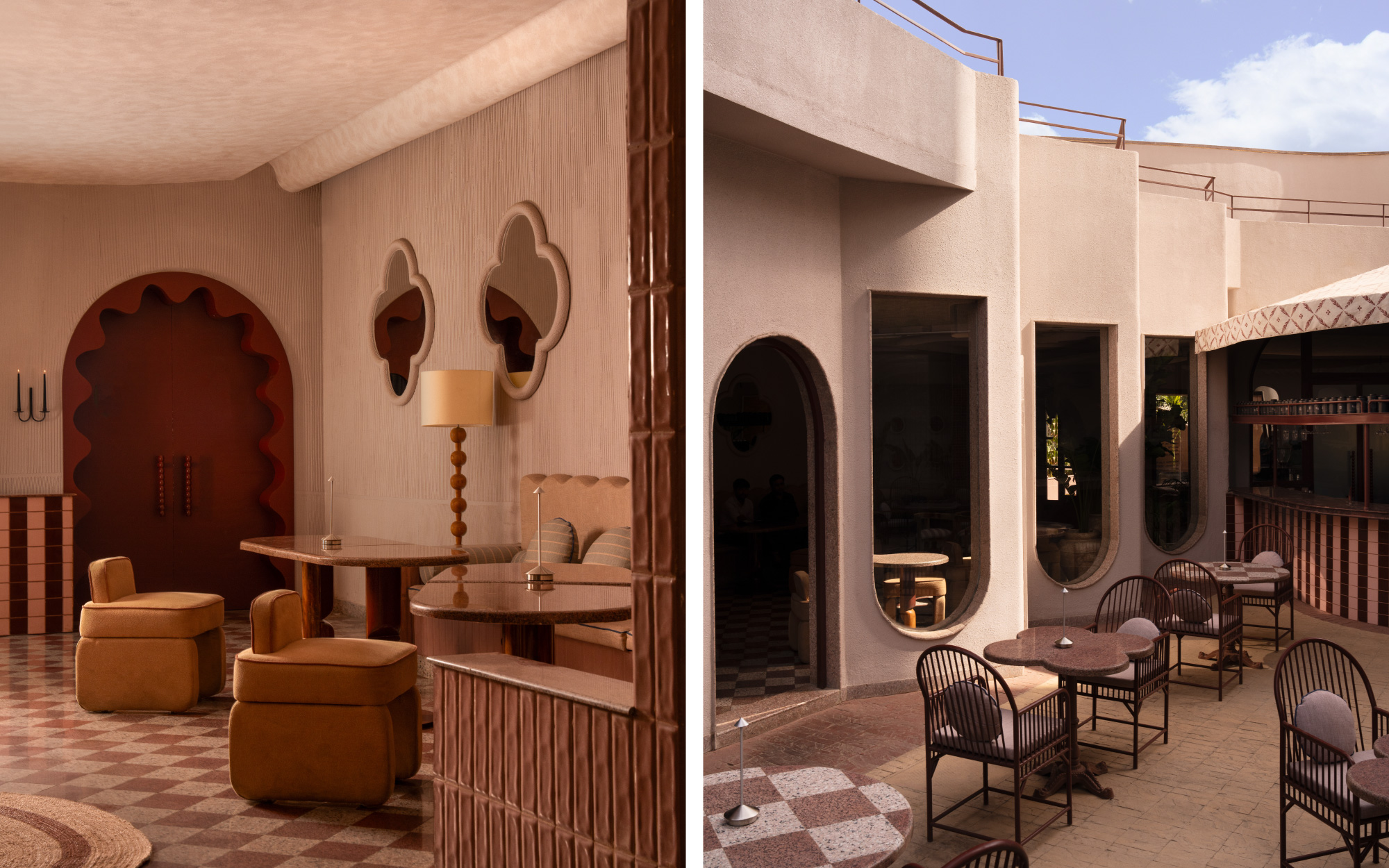
In keeping with Pantone Collective’s philosophy of spatial cohesion, Mirove’s furniture isn’t just sourced and placed, but built into the architecture. Every piece, from the curved banquettes to the scalloped seatbacks, was made-to-order and handcrafted on-site by local artisans. “All the furniture pieces were customised to align with the architectural language of the space. The built-in profiles blend seamlessly with the monolithic interiors, maintaining the continuity of form and materiality,” says Chutani.
The upholstery for Mirove was entirely custom-designed in-house, with bespoke prints developed exclusively for the project. Each print was crafted to reflect the colour theory and spatial language of the restaurant, ensuring the rouge-toned palette and overall design vocabulary tied together seamlessly. Subtle tonal variations and the use of linen blends, matte leathers, and soft velvets introduce warmth to the otherwise raw architectural shell. Every bespoke lighting fixture, too, extends this narrative; metal and glass lamps diffuse a soft, ambient glow that gently pools across tables, highlighting material grains and sculpting shadows throughout the space.
Materiality as Memory
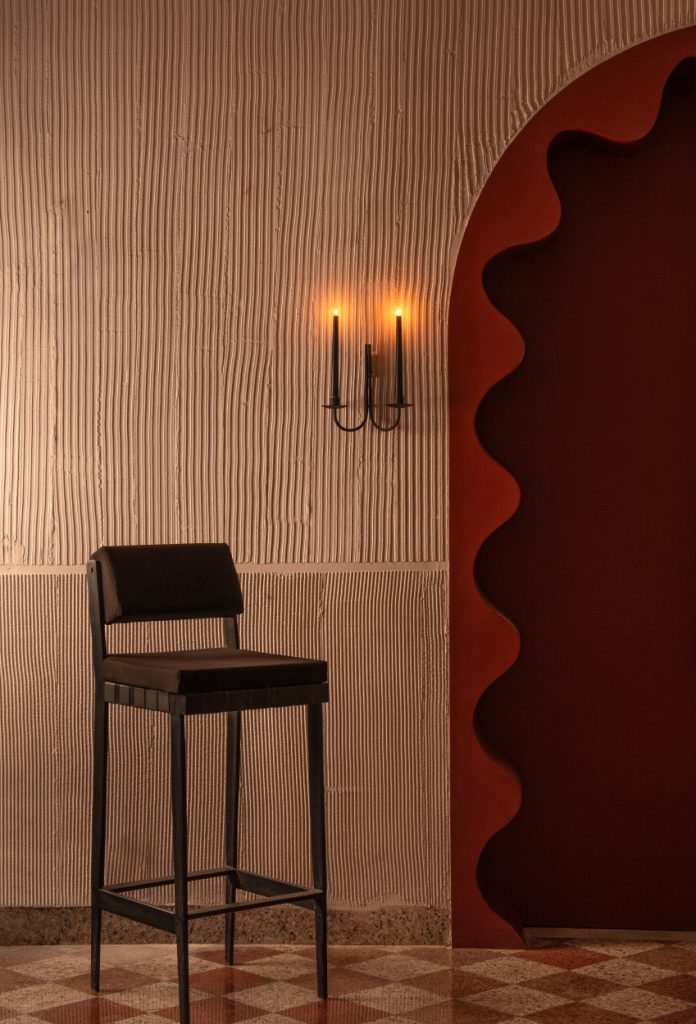
Mirove’s material range is a tribute to tactility. The heavy-grained plaster recalls the granular surfaces of Rajasthan’s forts, while the smooth ceramic tiles introduce a contemporary gloss. Granite, plaster, tile and light converge to create a sensorial journey, which goes from cool to warm, matte to glazed and still to shimmering. The result is a space that balances between the present and perennial, shaped by local cues yet relevant far beyond it. “It’s a great mix of old and new, where technology meets competence and human skill sets,” Chutani notes. There was no digitisation in the process. “Every design was hand-drawn, scaled with graph paper and executed by artisans who understood the poetry of precision.”
A Brutalist Narrative
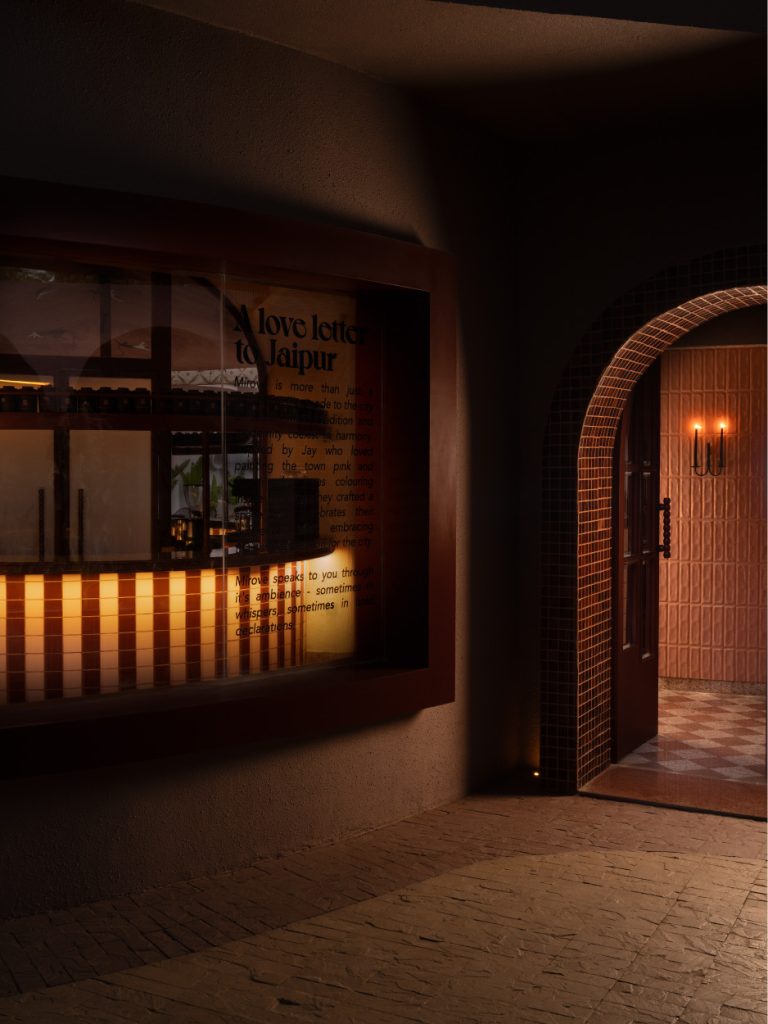
At its core, Mirove Artisanal Kitchen is not just a restaurant; it’s a clear expression of Jaipur’s identity. It captures the city’s DNA not through motifs or ornamentation, but through mood, memory and material. The brute strength of concrete is balanced with the delicacy of pink. “I’m drawn to the spaces that celebrate the everyday. For Mirove, we wanted to craft something that feels local and global.” In a city known for bold architectural interventions, Mirove stands out for its simplicity.